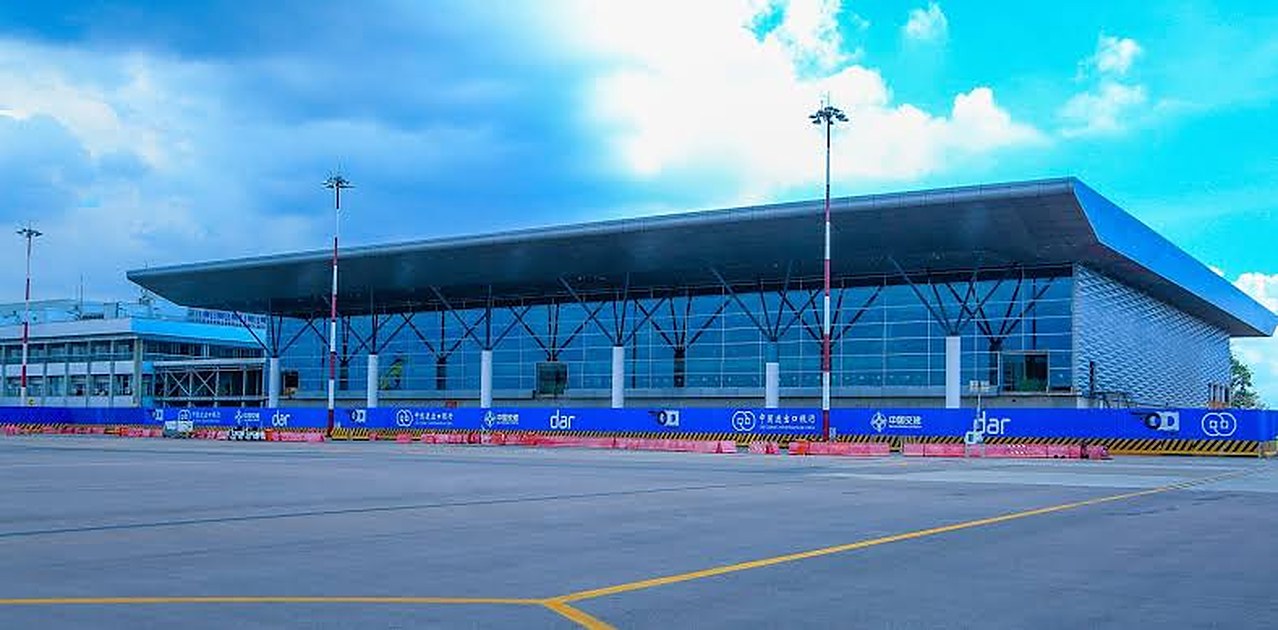
Photograph: Onyango George / EA Hospitality Pulse
Uganda counted 1.6 million visitors last year. Its holiday arrivals grew by 0.4 per cent.
The World Bank's November tourism brief puts Uganda down 7 per cent on the quarter while Rwanda is up 19. Uganda's own ministry says arrivals rose 3.7 per cent in the same half-year, its civil aviation authority says air traffic fell 10.8 per cent, and its park gates counted 7.9 per cent fewer people. All four numbers are real. Only one of them describes the market a lodge sells into.
On 20 August, at Entebbe International Airport, Olive Birungi Lumonya told a parliamentary committee that fewer people were flying into Uganda. The Acting Director General of the Uganda Civil Aviation Authority was hosting the Committee on Commissions, Statutory Authorities and State Enterprises, and her account of the first half of the year was blunt. Airspace over parts of the Middle East had closed on 28 February. An Ebola outbreak had thinned schedules. KLM had suspended operations on 30 May. "These developments inevitably affected passenger numbers, aircraft movements, airline revenues," she said, "and, consequently, aviation-related revenues accruing to the airport and other players in the value chain." The two factors, she told the committee, "led to a 10.8% reduction in international passenger traffic in the first 6 months of 2026 compared to the same period of 2025."
That same month, the Ministry of Tourism, Wildlife and Antiquities published its half-year statistics. International visitor arrivals for January to June 2026 came to 793,815, against 765,307 a year earlier: growth of 3.7 per cent. Arrivals recorded through Entebbe were up 4.7 per cent.
Two arms of the same government, describing the same six months at the same airport, reached opposite signs. Neither is lying. They are counting different people, and the gap between what they count has become the most important unreported fact in East African hospitality.
The World Bank widened that gap on 16 November. Its Tourism Watch brief for the month reported that international arrivals in Africa rose 4 per cent in the first half of 2026, the strongest of any world region, against 3 per cent for Europe, 2 per cent for the Americas and a fall of 22 per cent in the Middle East. That is the headline figure East African operators will see quoted in trade press and, by January, in their own 2027 rate letters. Buried further down the same brief is a table of estimated passenger arrivals for the second quarter, drawn from aviation data rather than from immigration counts. Eastern and Southern Africa managed 2 per cent. Inside that 2 per cent, Rwanda rose 19 per cent and Burundi rose 19 per cent, while Uganda fell 7 per cent, Madagascar fell 8 per cent and Eswatini fell 11 per cent.
A regional average of 2 per cent that contains a 30 point spread is not a forecast. It is a rounding error with a flag on it.
The reason the Ugandan numbers disagree so violently is structural, and it is printed in the ministry's own tables. Of the 793,815 visitors counted in the first half of this year, 556,306 arrived by road, or 70.1 per cent. Entebbe accounted for 237,509, under a third of the total. Any measure built on airport passenger movements, which is what the World Bank's quarterly estimate is, can see less than a third of the people Uganda counts as visitors, and it cannot see the Malaba and Katuna crossings at all. Both of those grew. Kenya supplied 249,427 visitors and Rwanda 187,541, which between them is 55 per cent of everybody who entered the country. Africa as a whole supplied 82.1 per cent.
So the civil aviation authority is right that fewer aircraft seats landed, and the ministry is right that more people arrived, because most of them came in a bus.
This is not pedantry about statistics. It decides whether a lodge in Bwindi should believe the national growth figure applies to it, and the answer is that it should not. The overseas segment, which is where almost all gorilla permits, premium bed-nights and transfer margin originate, is 17 per cent of Uganda's arrivals. It was the healthier half of the story: up 10.8 per cent to 134,953, with Europe up 28.6 per cent and the Americas up 14.1 per cent, offset by Asia falling 4.9 per cent as Indian arrivals dropped from 26,349 to 19,021. Africa, the other 82 per cent, grew 2.2 per cent. The headline is carried by the segment that does not buy the product, and the segment that does buy it is small enough that its real movements vanish into the average.
What makes this year different is that the physical indicators finally moved the other way, and moved hard.
Uganda's national parks received 166,836 visitors in the first half of 2026, down 7.9 per cent on the same period of 2025. Queen Elizabeth National Park, in the west, fell from 53,781 to 32,548. The Uganda Wildlife Education Centre was down 22.3 per cent. Gorilla permits sold came to 17,706, which is 49.9 per cent of the permits available, meaning the single highest-yielding product in the country ran at half capacity through a half-year in which the arrivals headline said growth. National hotel occupancy for January to April fell from 52.1 per cent to 49.8 per cent, against a government target of 55.3 per cent by the end of this decade. The Eastern region ran at 34 per cent. Kampala, at 63.8 per cent, held up.
Read in sequence, those are not the numbers of a destination growing at 3.7 per cent. They are the numbers of a destination whose visitor count rose while its gate receipts fell, because the additional visitors were not going through gates.
The ministry does not hide this. Its own report attributes the softness to specific causes: "This reduction in the growth rate of arrivals from the regions can be attributed to the Ebola outbreak and the ongoing conflict in the Middle East," it says, and notes elsewhere that "a much stronger performance could have been realised in the absence of the Ebola outbreak." The quarterly pattern fits. The first quarter was up 10.5 per cent. The second quarter was down 2.8 per cent. June alone fell 19.1 per cent, from 129,732 to 105,001. Average length of stay rose from 7.4 nights to 8.3, while spend per visitor per night fell from US$98 to US$95, which is the signature of a shift towards people staying with family rather than paying for rooms.
And the purpose-of-visit table, which almost nobody quotes, had already said as much a year earlier. When the ministry presented its performance review for the 2025/26 financial year in Kampala on 1 October, the figure that travelled was arrivals of 1,642,215 for 2025, up 19.7 per cent, with receipts of about US$1.62bn, up 21.3 per cent. Doreen S. Katusiime, the ministry's Permanent Secretary, told the conference that "tourism continues to contribute significantly to foreign exchange earnings, employment, household incomes and investment." Susan Nakawuki Nsambu, the Minister of State for Tourism, Wildlife and Antiquities, said the country needed to "strengthen the promotion of Uganda as a tourism destination if we are to achieve the tenfold growth ambition."
Underneath the 19.7 per cent sat the composition. Visiting friends and relatives accounted for 37 per cent of arrivals. Business and professional travel was 17.3 per cent, and it grew 82.9 per cent. Leisure and holiday travel was 16.2 per cent of arrivals, and it grew 0.4 per cent. Meetings and events were 4.5 per cent, and fell.
A country can add a quarter of a million visitors in a year, book a 21 per cent rise in receipts, and sell almost no additional holidays. Uganda did exactly that, and published the evidence.
Forty minutes away by air, Rwanda publishes the same industry a different way, and the difference is instructive. The Rwanda Development Board's annual report, released on 28 April, put 2025 receipts at US$685m, up 6 per cent, on 1.49 million visitors, up from 1.36 million. "Tourism maintained its strong momentum, with receipts reaching $685 million," wrote Itzhak Fisher, chairman of the RDB board. Rwanda's receipts are smaller than Uganda's reported figure by a wide margin. What Rwanda discloses is the breakdown: gorilla tourism at US$248m, up 7 per cent; visiting friends and relatives at US$180m, up 19 per cent; business travel at US$112m and broadly flat; education travel at US$64m. Meetings and events brought in US$94.7m, up from US$84.8m, across 165 international and regional events and 61,888 delegates, a rise of 17.3 per cent. Air arrivals grew 23 per cent while road arrivals grew 5 per cent.
An operator in Musanze can look at that and locate their own business inside it. An operator in Kasese cannot do the same with a national arrivals figure, because arrivals by purpose tells you who came and says nothing about what they spent, while revenue by segment tells you what was spent and lets you work backwards. Rwanda's 19 per cent on the World Bank's aviation proxy is consistent with its own 23 per cent growth in air arrivals, which is why that proxy worked for Rwanda and failed for Uganda: Rwanda's growth arrived through an airport.
The practical conclusion for the 2027 planning round is unglamorous. Stop quoting national arrivals in rate justifications, because the number has decoupled from the demand that pays, and a travel agent who checks will find the park gate figures. Build the rate case on the series that moves with your own revenue instead: park and reserve entries, permit utilisation, overseas arrivals as a separate line rather than a share, and your own occupancy against the regional average rather than the national one. Where a board or a lender asks for the headline, supply it with the composition attached.
One number deserves particular suspicion for the rest of this year. Lumonya's own figure appeared twice in the same report of her remarks, once as 10.8 per cent and once as 10.5 per cent, and nobody has reconciled them. Uganda's half-year report leaves 7,024 of its 793,815 arrivals unassigned to any region without explanation. These are small discrepancies in large tables, and they matter only because the whole industry is about to spend a planning season leaning on single figures drawn from exactly these tables. The figures are not wrong. They are answers to questions most operators are not asking.
📣 Telegram 💬 WhatsApp 💼 LinkedIn 📚 All guides